



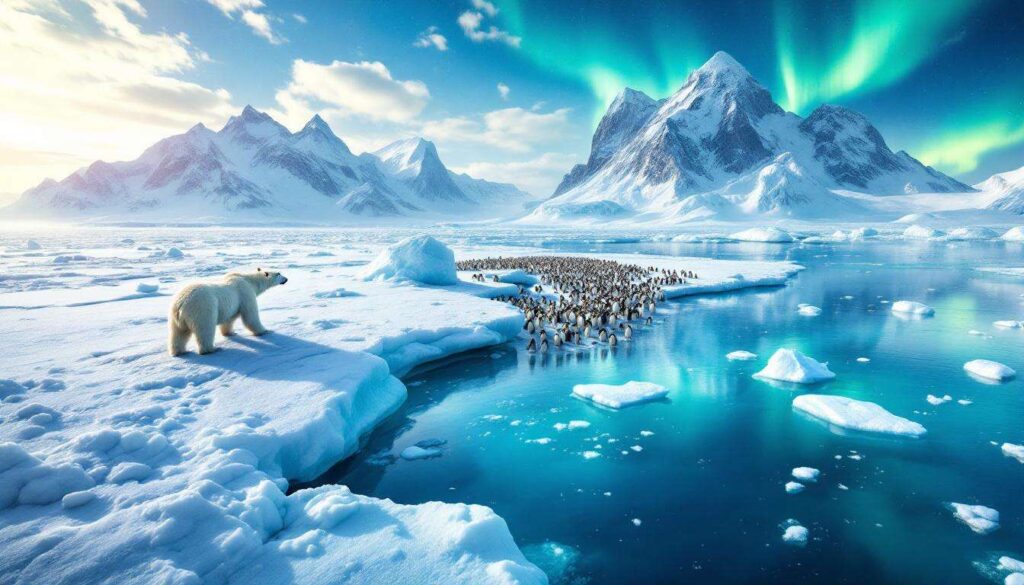
The frozen expanses at Earth’s extremities have captivated explorers, scientists, and adventurers for centuries. These remote wilderness areas represent the planet’s last great frontiers, offering unparalleled insights into our world’s climate systems, biodiversity, and geological history. Though both regions share icy landscapes and extreme conditions, the Arctic and Antarctic differ fundamentally in their geography, ecosystems, and the challenges they face in an era of rapid environmental change.
Discovering the geographical differences between the Arctic and Antarctic
Fundamental structural contrasts
The most striking difference between these polar regions lies in their basic composition. The Arctic consists primarily of ocean surrounded by continental landmasses, whilst the Antarctic is a continent surrounded by ocean. This fundamental distinction shapes everything from wildlife distribution to climate patterns. The Arctic Ocean, covered by shifting sea ice, sits at the centre of a region encompassing parts of Russia, Canada, Greenland, Alaska, and Scandinavia. In contrast, Antarctica stands as Earth’s fifth-largest continent, a landmass roughly 14 million square kilometres in size, almost entirely covered by ice sheets averaging 1.9 kilometres in thickness.
Elevation and ice characteristics
Antarctica’s continental nature gives it significant elevation advantages. The continent boasts an average elevation of 2,300 metres, making it the highest continent on Earth. Key geographical features include:
- The Transantarctic Mountains dividing East and West Antarctica
- Mount Vinson, the highest peak at 4,892 metres
- Ice shelves extending into surrounding waters
- Subglacial lakes hidden beneath kilometres of ice
The Arctic, conversely, features sea ice that typically measures only a few metres thick, floating atop ocean waters that reach depths exceeding 4,000 metres in places. Greenland, the Arctic’s largest landmass, holds the Northern Hemisphere’s only ice sheet, though it pales in comparison to Antarctica’s massive ice reserves.
Accessibility and human presence
Human habitation patterns differ markedly between the poles. The Arctic supports permanent indigenous communities numbering approximately four million people, including the Inuit, Sami, and various Russian Arctic peoples. These communities have adapted to polar conditions over millennia. Antarctica, however, has no indigenous population and no permanent residents beyond rotating scientific personnel at research stations. The Antarctic Treaty System, established in 1959, designates the continent for peaceful scientific purposes, prohibiting military activity and mineral exploitation.
These geographical distinctions create vastly different environments for the remarkable species that have adapted to polar life.
Unique wildlife: who inhabits the poles ?
Arctic terrestrial and marine species
The Arctic’s connected landmasses support a diverse array of terrestrial mammals that have evolved remarkable adaptations. Polar bears reign as apex predators, hunting seals on sea ice and representing one of the region’s most iconic species. Arctic foxes, caribou, musk oxen, and Arctic hares populate the tundra regions, whilst Arctic wolves patrol vast territories. Marine life thrives in Arctic waters, with species including:
- Walruses congregating on ice floes and coastal areas
- Several seal species, including ringed, bearded, and harp seals
- Beluga and narwhal whales navigating icy channels
- Bowhead whales, amongst Earth’s longest-lived mammals
Antarctic marine dominance
Antarctica’s isolation and lack of land connections to other continents has resulted in purely marine mammal populations. No terrestrial mammals exist naturally on the continent. Instead, the Southern Ocean teems with life adapted to frigid waters. Penguin species, including emperors, Adélies, chinstraps, and gentoos, dominate the avian landscape, with emperors breeding during the brutal Antarctic winter. Seal populations include Weddell, crabeater, leopard, and Ross seals, each occupying distinct ecological niches. The waters support numerous whale species during summer months, including humpbacks, minkes, and the massive blue whale.
Microscopic marvels and marine foundations
Both polar regions depend heavily on microscopic organisms. Antarctic krill, small crustaceans measuring only about six centimetres, form the foundation of the Southern Ocean food web, with an estimated biomass exceeding 500 million tonnes. Arctic waters similarly depend on copepods and other zooplankton. Phytoplankton blooms during polar summers provide the energy base supporting entire ecosystems, demonstrating how life persists even in Earth’s harshest environments.
| Wildlife Category | Arctic | Antarctic |
|---|---|---|
| Large land predators | Polar bears, wolves | None |
| Penguin species | None | 17 species |
| Indigenous human populations | ~4 million | None |
These remarkable creatures must contend with some of the planet’s most demanding environmental conditions.
Extreme climate: survival and environmental challenges
Temperature extremes and records
Antarctica holds the distinction of recording Earth’s lowest temperature: minus 89.2 degrees Celsius at Vostok Station in 1983. More recent satellite measurements have detected surface temperatures approaching minus 98 degrees Celsius in East Antarctica’s high-altitude interior. The Arctic, whilst undeniably cold, experiences relatively milder conditions due to the moderating influence of ocean waters beneath the ice. Arctic winter temperatures typically range from minus 40 to minus 30 degrees Celsius, considerably warmer than Antarctic readings.
Wind, precipitation, and polar deserts
Both regions qualify as polar deserts due to minimal precipitation. Antarctica receives less annual precipitation than the Sahara Desert in many areas, with some interior regions receiving less than 50 millimetres annually. Katabatic winds, formed by dense cold air flowing downslope from the interior ice sheet, can exceed 300 kilometres per hour, creating blizzard conditions even without snowfall. The Arctic experiences more moderate wind patterns, though blizzards remain common during winter months.
Adaptations for survival
Organisms surviving polar extremes have developed extraordinary adaptations:
- Antifreeze proteins in fish blood preventing ice crystal formation
- Thick blubber layers insulating marine mammals
- Hollow guard hairs trapping air for insulation in polar bears
- Counter-current heat exchange systems minimising heat loss
- Behavioural adaptations including huddling and seasonal migration
Emperor penguins exemplify extreme adaptation, breeding during Antarctic winter when temperatures plummet and winds rage. Males incubate eggs on their feet beneath feathered brood pouches, fasting for over 100 days whilst females hunt at sea.
These natural adaptations, refined over millennia, now face unprecedented challenges as global temperatures rise.
The impact of climate change on polar regions
Warming rates and feedback loops
Polar regions are warming at rates significantly exceeding the global average, a phenomenon known as Arctic amplification. The Arctic has warmed approximately twice as fast as the planet overall, with some areas experiencing temperature increases exceeding three degrees Celsius since pre-industrial times. This accelerated warming results from feedback mechanisms, particularly the ice-albedo feedback: as white reflective ice melts, it exposes darker ocean or land surfaces that absorb more solar radiation, causing further warming.
Sea ice decline and consequences
Arctic sea ice extent has declined dramatically, with September minimums decreasing approximately 13 per cent per decade since satellite monitoring began in 1979. This loss affects:
- Polar bear hunting opportunities and survival rates
- Indigenous communities’ traditional hunting practices
- Global weather patterns and jet stream behaviour
- Shipping routes and resource extraction possibilities
Antarctic sea ice patterns prove more variable and complex, with some regions experiencing increases whilst others decline, though recent years have shown concerning overall decreases.
Ice sheet dynamics and sea level implications
The Greenland and Antarctic ice sheets hold enough frozen water to raise global sea levels by over 65 metres if completely melted. Current observations show accelerating ice loss, particularly from Greenland and West Antarctica. The Antarctic Peninsula has warmed by nearly three degrees Celsius over recent decades, causing dramatic ice shelf collapses. Scientists monitor glaciers like Thwaites Glacier in West Antarctica, dubbed the “Doomsday Glacier” due to its potential to contribute significantly to sea level rise if it destabilises.
| Impact | Arctic | Antarctic |
|---|---|---|
| Warming rate vs global average | 2-3 times faster | Variable, Peninsula warming rapidly |
| Sea ice trend (recent decades) | Strong decline | Variable, recent declines |
| Potential sea level contribution | ~7 metres (Greenland) | ~58 metres |
Understanding these changes builds upon centuries of polar exploration that have gradually revealed these regions’ secrets.
Historical and current explorations in icy regions
The heroic age and race to the poles
The late 19th and early 20th centuries witnessed the Heroic Age of Antarctic Exploration, characterised by expeditions pushing human endurance to its limits. Roald Amundsen’s Norwegian team reached the South Pole on 14 December 1911, whilst Robert Falcon Scott’s British expedition arrived 34 days later, perishing on the return journey. Arctic exploration similarly captured public imagination, with Robert Peary claiming to have reached the North Pole in 1909, though this remains disputed. These expeditions relied on sledges, dogs, and human determination, operating without modern technology or communication systems.
Scientific research stations and international cooperation
Modern polar exploration emphasises scientific research over geographical conquest. Antarctica hosts over 70 permanent research stations operated by 29 countries, with populations swelling during summer months. Research focuses on:
- Climate science and ice core analysis revealing past atmospheric conditions
- Astronomy and astrophysics benefiting from clear, dry air
- Marine biology and ecosystem studies
- Geology and the search for meteorites
- Space analogue research for Mars missions
The Arctic similarly hosts numerous research facilities, though its accessibility and indigenous populations create different research dynamics.
Contemporary technological advances
Twenty-first-century polar research employs sophisticated technology including satellite monitoring, autonomous underwater vehicles, ice-penetrating radar, and remote sensing systems. These tools enable scientists to monitor ice sheet dynamics, track wildlife populations, and measure environmental changes with unprecedented precision. International programmes like the International Polar Year foster collaborative research addressing global questions.
This expanding scientific knowledge increasingly informs efforts to protect these vulnerable ecosystems.
Protection and conservation of polar ecosystems
International agreements and governance
The Antarctic Treaty System represents one of the world’s most successful international agreements, designating Antarctica as a natural reserve devoted to peace and science. The Protocol on Environmental Protection, adopted in 1991, prohibits mineral resource activities and establishes comprehensive environmental protection measures. Arctic governance proves more complex, involving sovereign nations with territorial claims, though agreements like the Arctic Council facilitate cooperation on environmental issues.
Protected areas and wildlife conservation
Both regions feature designated protected areas safeguarding critical habitats. Antarctic Specially Protected Areas and Marine Protected Areas shield breeding colonies, pristine environments, and representative ecosystems. Conservation challenges include:
- Regulating tourism to minimise environmental impact
- Preventing invasive species introductions
- Managing fishing activities sustainably
- Addressing pollution, including microplastics
- Monitoring and mitigating climate change effects
Future conservation priorities
Effective polar conservation requires addressing global climate change whilst implementing regional protection measures. Proposed initiatives include expanding marine protected areas, strengthening fishing regulations, and enhancing monitoring capabilities. Indigenous Arctic communities increasingly participate in conservation decisions, bringing traditional ecological knowledge to complement scientific understanding. International cooperation remains essential, as polar regions’ environmental health affects the entire planet through climate regulation, ocean circulation, and biodiversity maintenance.
The poles stand at the forefront of environmental change, serving as early warning systems for planetary health. Their protection demands sustained global commitment, recognising that these remote regions fundamentally influence conditions far beyond their icy boundaries. Scientific research continues revealing new insights into polar ecosystems, whilst conservation efforts work to preserve these extraordinary environments for future generations. The contrast between Arctic and Antarctic—one an ocean surrounded by land, the other land surrounded by ocean—reminds us of nature’s diversity even in Earth’s most extreme environments, each requiring tailored approaches to understanding and protection.