


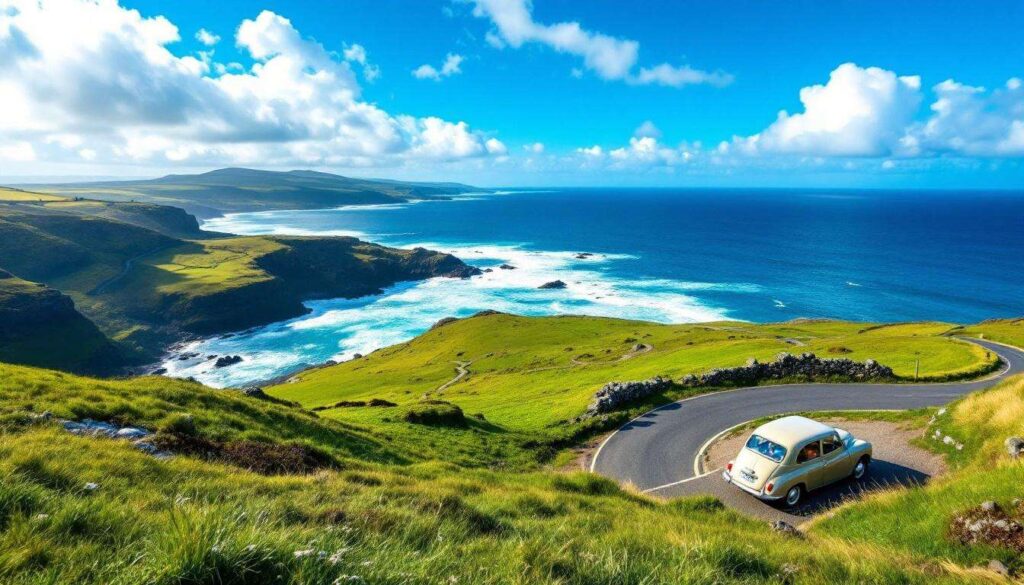
Stretching over 2,500 kilometres along Ireland’s western coastline, the Wild Atlantic Way presents one of Europe’s most dramatic coastal drives. This legendary route rivals Scotland’s celebrated North Coast 500, offering travellers an equally compelling journey through rugged landscapes, ancient heritage sites, and vibrant coastal communities. From the windswept cliffs of County Cork to the remote headlands of Donegal, this spectacular road trip showcases Ireland’s untamed beauty at its finest.
Introduction to the Wild Atlantic Way
Understanding the Route’s Geography
The Wild Atlantic Way traces Ireland’s entire western seaboard, connecting nine counties and countless villages along the Atlantic coast. This touring route officially begins in Kinsale, County Cork, and extends northward to Malin Head in County Donegal, representing Ireland’s longest defined coastal drive.
- Total distance: approximately 2,500 kilometres
- Counties traversed: Cork, Kerry, Limerick, Clare, Galway, Mayo, Sligo, Leitrim, and Donegal
- Estimated driving time: minimum seven days for the complete route
- Discovery points: over 150 designated stops along the way
Planning Your Journey
Unlike the North Coast 500, which forms a convenient loop, the Wild Atlantic Way requires strategic planning. Most travellers focus on specific sections rather than attempting the entire route in one journey. The journey rewards those who embrace spontaneity, as hidden beaches, traditional pubs, and unexpected viewpoints appear around every coastal bend.
The route divides naturally into three distinct sections: the southern stretch from Cork to Clare, the central region encompassing Galway and Mayo, and the northern reaches through Sligo to Donegal. Each section offers unique characteristics and can be explored independently.
Having established the scope of this remarkable coastal drive, the journey properly begins on one of Ireland’s most celebrated peninsulas.
Discovering the Dingle Peninsula
Slea Head Drive
The Dingle Peninsula represents the Wild Atlantic Way at its most enchanting and accessible. The Slea Head Drive, a circular route around the peninsula’s western tip, delivers breathtaking coastal scenery alongside significant archaeological sites. This 47-kilometre loop passes ancient beehive huts, early Christian settlements, and pristine beaches where the Atlantic crashes against golden sands.
Cultural Significance
Dingle town itself serves as the peninsula’s vibrant heart, where traditional Irish culture thrives in cosy pubs and artisan shops. The area remains one of Ireland’s strongest Gaeltacht regions, where Irish is still spoken as a first language by many residents.
| Attraction | Type | Approximate Duration |
|---|---|---|
| Slea Head Drive | Scenic route | 2-3 hours |
| Gallarus Oratory | Historical site | 30 minutes |
| Inch Beach | Natural attraction | 1-2 hours |
Beyond the peninsula’s natural beauty, visitors discover layers of history etched into the landscape, from Bronze Age standing stones to early Christian monasteries. The journey northward from Dingle leads to one of Ireland’s most iconic natural wonders.
The Cliffs of Moher: a Natural Spectacle
Experiencing the Cliffs
Rising 214 metres above the Atlantic Ocean, the Cliffs of Moher represent Ireland’s most visited natural attraction and a defining highlight of the Wild Atlantic Way. These dramatic sea cliffs stretch for eight kilometres along the Clare coast, offering perspectives that shift dramatically with changing weather and light conditions.
The visitor experience extends beyond simply viewing the cliffs themselves. The modern visitor centre, built into the hillside, provides context through interactive exhibitions exploring the geology, wildlife, and human history of this remarkable location.
Wildlife and Natural Heritage
The cliffs support significant seabird populations, making them an internationally important breeding site. During spring and summer months, the cliff faces teem with life as thousands of birds nest on narrow ledges.
- Over 20,000 breeding pairs of seabirds
- Species include puffins, razorbills, guillemots, and kittiwakes
- Part of the Burren and Cliffs of Moher UNESCO Global Geopark
- Protected Special Protection Area for bird conservation
Practical Considerations
Visiting the Cliffs of Moher requires respect for both safety guidelines and natural preservation efforts. Weather conditions can change rapidly, with strong winds and sudden rain common even during summer months. The designated pathways ensure visitor safety whilst protecting the fragile cliff-edge ecosystem.
Continuing northward along the coast, the route reaches a region where land and sea merge in perfect harmony.
The Charm of Galway Bay
Coastal Villages and Towns
Galway Bay sweeps in a graceful arc from the Burren in County Clare to Connemara in County Galway, creating a sheltered inlet dotted with characterful coastal settlements. The bay’s southern shore follows the distinctive limestone landscape of the Burren, whilst its northern reaches embrace the rugged beauty of Connemara.
Kinvara, positioned at the bay’s southeastern corner, exemplifies the charm of these coastal villages. Its medieval castle, Dunguaire, stands sentinel over the harbour where traditional Galway hookers once plied their trade. These distinctive sailing vessels, with their dark hulls and rust-coloured sails, occasionally still grace the bay during festivals and regattas.
Galway City
At the bay’s northeastern corner, Galway city pulses with creative energy and cultural vitality. This compact city combines medieval heritage with contemporary arts, traditional music sessions with innovative theatre, and historic architecture with modern design. The city’s Latin Quarter, centred around Shop Street and Quay Street, draws visitors into a maze of narrow lanes filled with independent shops, galleries, and restaurants.
| Location | Key Feature | Distance from Galway City |
|---|---|---|
| Kinvara | Dunguaire Castle | 25 km |
| Spiddal | Gaeltacht village | 19 km |
| Salthill | Promenade | 3 km |
The bay also serves as the departure point for one of Ireland’s most distinctive island experiences.
Exploring the Aran Islands
Three Islands, Three Personalities
The three Aran Islands—Inis Mór, Inis Meáin, and Inis Oírr—guard the entrance to Galway Bay like ancient sentinels. Each island maintains its own distinct character and atmosphere, united by shared traditions of Irish language, stone-wall craftsmanship, and resilient island life.
Inis Mór, the largest island, attracts most visitors with its dramatic cliff fort of Dún Aonghasa, perched precariously on sheer cliffs 100 metres above the Atlantic. This prehistoric stone fort, dating back over 2,000 years, represents one of Europe’s most spectacular ancient monuments.
Island Life and Traditions
The islands’ distinctive landscape results from centuries of human endeavour. Islanders created fields from bare rock by spreading seaweed and sand over limestone, then enclosing these precious plots with intricate networks of dry-stone walls. These walls, stretching for hundreds of kilometres across the islands, represent one of Ireland’s most impressive examples of traditional craftsmanship.
- Traditional transport: bicycles, pony and trap, or walking
- Primary language: Irish (Gaeilge)
- Famous knitwear: Aran sweaters with distinctive patterns
- Access: ferry services from Rossaveal or Doolin, or flights from Connemara Airport
Practical Island Visiting
Day trips to the islands prove popular, though overnight stays allow deeper immersion in island rhythms. Ferry crossings can be affected by weather conditions, particularly during winter months, so flexibility in planning proves essential.
Returning to the mainland and continuing northward, the landscape transforms once more as the route enters another region rich in mythology and natural beauty.
The Enchanting Landscapes of the Sligo Region
Yeats Country
County Sligo, forever associated with poet William Butler Yeats, presents a landscape where myth and reality intertwine. The distinctive flat-topped profile of Benbulben mountain dominates the northern skyline, its limestone cliffs rising abruptly from surrounding farmland. This iconic peak featured repeatedly in Yeats’s poetry and remains central to the region’s identity.
The coastline around Sligo town offers dramatic contrasts, from the surf beaches of Strandhill and Mullaghmore to the sheltered harbour at Rosses Point. These beaches attract surfers year-round, with Atlantic swells providing consistent waves even during summer months.
Archaeological Treasures
The Sligo region contains one of Ireland’s highest concentrations of megalithic monuments. Carrowmore, just outside Sligo town, represents the largest cemetery of megalithic tombs in Ireland, with over 60 monuments dating back 5,000 years.
- Carrowmore Megalithic Cemetery: over 60 tombs
- Knocknarea: cairn traditionally associated with Queen Maeve
- Creevykeel Court Tomb: one of Ireland’s finest examples
- Carrowkeel: remote hilltop passage tombs with panoramic views
Coastal Highlights
Mullaghmore Head, jutting into the Atlantic in northern Sligo, provides spectacular coastal walking and surfing opportunities. The village’s small harbour shelters beneath Classiebawn Castle, a Gothic Revival mansion perched dramatically on the headland. The area’s wild beauty exemplifies the untamed character that defines the Wild Atlantic Way’s northern reaches.
| Site | Type | Historical Period |
|---|---|---|
| Carrowmore | Megalithic cemetery | Neolithic (3,000 BCE) |
| Knocknarea | Passage tomb | Neolithic |
| Creevykeel | Court tomb | Neolithic |
The Wild Atlantic Way’s journey through Ireland’s western coastline offers travellers an unparalleled exploration of natural beauty, ancient heritage, and living culture. From the Dingle Peninsula’s archaeological treasures to the Cliffs of Moher’s dramatic heights, from Galway Bay’s welcoming shores to the Aran Islands’ timeless traditions, and through Sligo’s mythological landscapes, this route delivers experiences that rival any coastal drive in Europe. Each stop along the way reveals another facet of Ireland’s complex relationship with the Atlantic, where communities have thrived for millennia despite—or perhaps because of—the ocean’s constant presence. The Wild Atlantic Way stands as testament to both nature’s raw power and human resilience, offering modern travellers a journey through landscapes that continue to inspire, challenge, and captivate all who venture along this remarkable coast.