



Choosing between rail and air travel for the London-to-Edinburgh route presents a genuine dilemma for modern travellers. Both options promise to connect England’s capital with Scotland’s historic city, yet they deliver vastly different experiences. To settle this debate, an actual journey was undertaken using both modes of transport, comparing costs, comfort, environmental impact and overall convenience. The results reveal surprising insights that challenge common assumptions about budget travel between these two major British cities.
Cost comparison: train versus budget flight
Ticket prices and booking strategies
The financial aspect of this comparison proved more complex than anticipated. A budget flight from London Stansted to Edinburgh was priced at £42.99 when booked three weeks in advance, whilst the train ticket purchased at the same time cost £89.00 for an off-peak advance fare. However, these headline figures only tell part of the story.
When factoring in the total journey cost, the gap narrows considerably. The flight required:
- Transport to Stansted Airport: £19.00 by train from central London
- Checked baggage fee: £25.00
- Airport food and refreshments: £12.00
- Bus transfer from Edinburgh Airport to city centre: £7.50
Hidden expenses that matter
The train journey, by contrast, departed from King’s Cross station in central London and arrived at Edinburgh Waverley in the heart of the Scottish capital, requiring no additional transport costs. Food and drink were optional, with the freedom to bring one’s own provisions without restriction.
| Expense category | Budget flight | Train |
|---|---|---|
| Base ticket | £42.99 | £89.00 |
| Additional transport | £26.50 | £0.00 |
| Baggage fees | £25.00 | £0.00 |
| Food and drink | £12.00 | £0.00 |
| Total cost | £106.49 | £89.00 |
This comprehensive breakdown demonstrates that the supposedly budget flight actually cost £17.49 more than the train when all expenses were considered. These findings naturally lead to questions about another crucial factor: the time investment required for each journey.
Travel time: which is faster ?
Door-to-door journey duration
The flight duration from London Stansted to Edinburgh was advertised at just 1 hour 20 minutes, creating the impression of a significantly faster journey. The train, meanwhile, required 4 hours 30 minutes of actual travel time. Yet this comparison proved misleading when examining the complete door-to-door experience.
The flight journey timeline included:
- Travel to Stansted Airport: 50 minutes
- Recommended arrival time before departure: 2 hours
- Actual flight time: 1 hour 20 minutes
- Baggage collection: 25 minutes
- Transfer to Edinburgh city centre: 35 minutes
The reality of airport procedures
Adding these segments together revealed a total journey time of approximately 5 hours 10 minutes for the flight option. The train journey, departing from central London and arriving in central Edinburgh, required no additional transfers or waiting periods beyond the 4 hours 30 minutes spent on board.
Furthermore, the train allowed productive use of time throughout the journey, with reliable Wi-Fi connectivity and spacious seating with tables. The flight experience involved prolonged periods of waiting in terminals where working proved difficult. Beyond mere duration, the quality of time spent travelling deserves careful examination.
On-board comfort: train or plane ?
Space and amenities
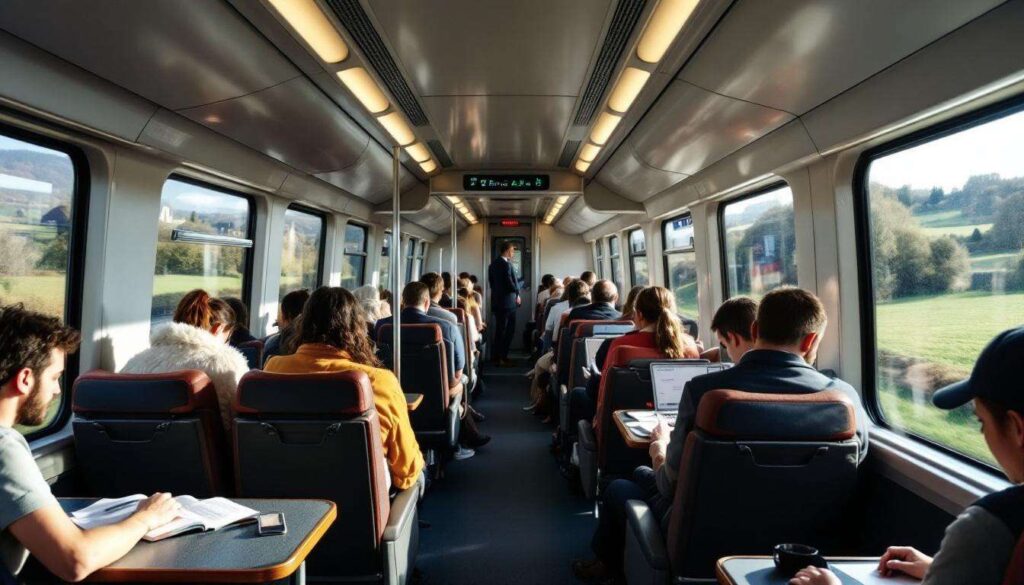
The contrast in on-board comfort was immediately apparent. The train offered generous legroom, wide seats with adjustable headrests, and large tables suitable for laptop work. Movement throughout the carriage was unrestricted, with frequent opportunities to stretch one’s legs, visit the café car, or simply change scenery.
The budget flight provided a starkly different experience. Cramped seating with minimal legroom made the journey uncomfortable, particularly for taller passengers. The middle seat position, assigned during this test, offered no window view and restricted access to the aisle.
Connectivity and productivity
Working during travel has become essential for many passengers. The train excelled in this regard, offering:
- Complimentary Wi-Fi throughout the journey
- Power sockets at every seat
- Quiet zones for concentration
- Mobile phone signal for most of the route
The flight offered none of these amenities without additional charges. Electronic devices required switching to flight mode, eliminating connectivity for the airborne portion of the journey. This limitation extended the period of enforced disconnection to nearly three hours when including boarding and taxiing time.
Comfort considerations naturally extend beyond the immediate travel experience to encompass broader environmental responsibilities that increasingly influence travel decisions.
Carbon emissions: which mode of transport is greener ?
Environmental impact analysis
The carbon footprint comparison revealed a substantial difference between the two transport modes. According to data from the Department for Transport, the flight from London to Edinburgh generated approximately 144 kilograms of CO₂ equivalent per passenger, whilst the train journey produced just 22 kilograms.
| Transport mode | CO₂ emissions per passenger | Percentage difference |
|---|---|---|
| Budget flight | 144 kg CO₂e | Baseline |
| Train | 22 kg CO₂e | 85% lower |
Sustainability considerations
The train’s environmental advantage stems from electric traction powered increasingly by renewable energy sources. The East Coast Main Line, which serves the London-Edinburgh route, operates entirely on electric power, with the UK’s electricity grid becoming progressively greener each year.
For environmentally conscious travellers, this represents a compelling argument in favour of rail travel. The carbon saving of 122 kilograms per journey equates to the emissions produced by driving approximately 300 miles in an average petrol car. Environmental credentials aside, practical considerations regarding station and airport locations significantly influence the overall travel experience.
Accessibility and convenience: departures and arrivals
Location advantages
The train’s departure from King’s Cross station in central London provided immediate accessibility via multiple Underground lines, buses, and taxis. Edinburgh Waverley station similarly sits in the heart of Scotland’s capital, mere minutes from Princes Street and major hotels.
Stansted Airport, conversely, lies 40 miles northeast of central London, requiring dedicated travel time and expense. Edinburgh Airport, whilst closer to the city than Stansted is to London, still necessitates a bus or taxi journey to reach the centre.
Frequency and flexibility
Train services between London and Edinburgh operate with impressive frequency:
- Departures every 30 minutes during peak periods
- Hourly services throughout most of the day
- Early morning and late evening options available
- Flexible ticket changes possible with advance fares
Budget flights offered fewer daily departures, typically three to four services, with rigid change policies incurring substantial fees. The train’s flexibility proved particularly valuable when plans shifted unexpectedly. These practical advantages combine with subjective elements to create the complete picture of each travel option.
User experience: personal satisfaction and recommendations
Overall journey satisfaction
The subjective experience of train travel proved markedly superior. The ability to move freely, work productively, enjoy changing landscapes through large windows, and avoid the stress of airport security created a genuinely pleasant journey. The train felt less like a necessary inconvenience and more like a valuable part of the travel experience itself.
The flight, whilst brief in actual airborne time, involved considerable stress and discomfort. Airport security queues, cramped seating, and the general hassle of air travel detracted significantly from the experience. The journey felt like something to be endured rather than enjoyed.
Practical recommendations
Based on this comprehensive comparison, the train emerges as the clear winner for the London-Edinburgh route when considering:
- Total journey cost including all ancillary expenses
- Door-to-door travel time
- On-board comfort and productivity
- Environmental impact
- Convenience of central station locations
The budget flight might appeal to those prioritising the lowest headline ticket price or requiring very specific departure times unavailable by train. However, for most travellers, particularly those departing from and arriving in the city centres, the train offers superior value, comfort, and overall experience.
This real-world test conclusively demonstrated that the train provides a more economical, comfortable, and environmentally responsible option for travelling between London and Edinburgh. The supposed speed advantage of flying evaporates when accounting for airport procedures and transfers, whilst the budget airline’s low base fare masks the true cost of the journey. For those willing to look beyond headline prices and flight times, the railway offers a compelling alternative that transforms travel from a tedious necessity into an enjoyable experience. The environmental benefits provide an additional incentive for choosing rail, making the train the clear winner across virtually every meaningful metric.