



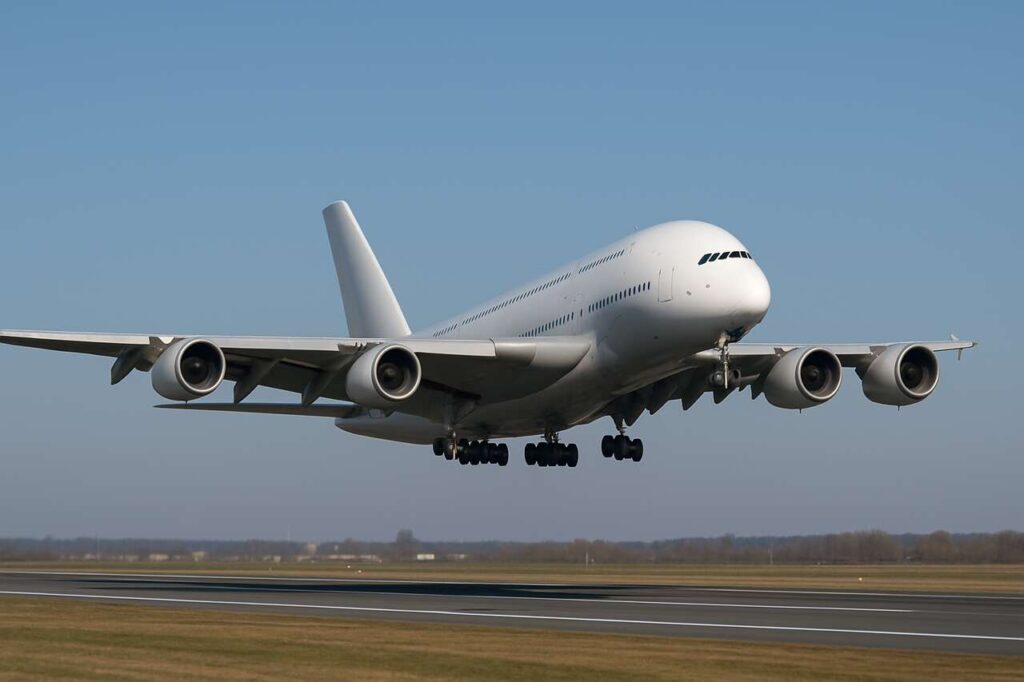
The Airbus A380 stands as an engineering marvel in modern aviation, representing the pinnacle of commercial aircraft design with its unprecedented passenger capacity and distinctive double-deck configuration. However, one aspect of its performance often raises questions amongst aviation enthusiasts and professionals alike: its relatively modest climb rate compared to other wide-body aircraft. This characteristic stems from a complex interplay of aerodynamic principles, weight considerations, and design compromises that define the operational profile of this super-jumbo jet.
Technical features of the Airbus A380
Dimensions and structural characteristics
The A380 represents extraordinary dimensions in commercial aviation, with a wingspan of 79.75 metres and an overall length of 72.72 metres. Its maximum takeoff weight reaches 575,000 kilograms, making it the heaviest passenger aircraft currently in service. The aircraft features a full-length double-deck fuselage, providing a total floor area of 845 square metres across two passenger decks.
| Specification | Measurement |
|---|---|
| Wingspan | 79.75 m |
| Length | 72.72 m |
| Height | 24.09 m |
| Maximum takeoff weight | 575,000 kg |
Powerplant configuration
The A380 relies on four high-bypass turbofan engines, available in two variants: the Rolls-Royce Trent 900 or the Engine Alliance GP7200. Each engine produces approximately 70,000 to 80,000 pounds of thrust, resulting in a total thrust output of around 280,000 to 320,000 pounds. Whilst this appears substantial, the thrust-to-weight ratio remains relatively modest when compared to the aircraft’s massive weight, particularly during takeoff and initial climb phases.
- Four turbofan engines per aircraft
- Individual engine thrust: 70,000-80,000 lbs
- Total thrust output: approximately 300,000 lbs
- Thrust-to-weight ratio: approximately 0.25 at maximum takeoff weight
These technical specifications establish the foundation for understanding why the A380’s climb performance differs significantly from smaller, lighter aircraft operating in commercial service.
Comparison with other aircraft models
Climb rate benchmarks
The A380 typically achieves a climb rate between 1,000 and 1,500 feet per minute during its initial ascent, depending on weight and atmospheric conditions. This figure contrasts notably with other wide-body aircraft that demonstrate superior climbing capabilities.
| Aircraft model | Typical climb rate (fpm) | Thrust-to-weight ratio |
|---|---|---|
| Airbus A380 | 1,000-1,500 | 0.25 |
| Boeing 777-300ER | 1,800-2,200 | 0.30 |
| Boeing 787-9 | 2,000-2,500 | 0.32 |
| Airbus A350-900 | 2,100-2,400 | 0.31 |
Performance advantages of twin-engine designs
Modern twin-engine wide-body aircraft benefit from technological advances that provide superior power-to-weight ratios. The Boeing 777 and Airbus A350, for instance, utilise highly efficient engines that deliver exceptional thrust whilst maintaining lower overall aircraft weight. These aircraft demonstrate climb rates approximately 40 to 60 per cent higher than the A380, enabling more flexible flight profiles and improved operational efficiency.
Such performance differences influence operational considerations, including air traffic management, fuel planning, and route optimisation strategies employed by airlines worldwide.
Factors influencing climb rate
Aerodynamic considerations
The A380’s aerodynamic profile reflects design priorities favouring cruise efficiency over climb performance. Its large wing area of 845 square metres generates substantial lift at cruising altitudes but creates significant induced drag during climb phases. The aspect ratio and wing loading characteristics optimise fuel efficiency during long-haul cruise operations rather than maximising vertical speed capability.
Atmospheric conditions and altitude effects
Air density plays a critical role in determining climb performance across all aircraft types. As altitude increases, the reduced air density diminishes both engine thrust and aerodynamic lift generation. For the A380, this effect proves particularly pronounced due to its substantial mass requiring sustained high thrust levels throughout the climb profile.
- Engine performance decreases approximately 3-4 per cent per 1,000 feet of altitude gain
- Reduced air density affects lift generation and thrust production simultaneously
- Temperature variations influence air density and engine efficiency
- Wind conditions can significantly impact ground-referenced climb rate
Operational limitations and regulations
Air traffic control procedures often impose speed restrictions during climb phases, particularly in congested airspace. These limitations, typically 250 knots below 10,000 feet, constrain the energy available for vertical climb, forcing pilots to balance airspeed and vertical velocity carefully.
Understanding these multifaceted influences provides context for examining how weight specifically affects the A380’s climbing capability.
Impact of weight on performance
Maximum takeoff weight considerations
The A380’s maximum takeoff weight of 575,000 kilograms represents the primary constraint on climb performance. This massive weight requires substantial thrust merely to maintain level flight, leaving limited excess power available for climbing. The relationship between weight and climb rate follows an inverse correlation: as weight increases, available climb performance decreases proportionally.
Payload and fuel load variations
Airlines configure the A380 with varying passenger loads and fuel quantities depending on route requirements. A fully loaded A380 departing on an ultra-long-haul route experiences significantly reduced climb capability compared to a lightly loaded aircraft on a shorter sector. This variability necessitates careful flight planning to ensure adequate performance margins throughout all flight phases.
| Configuration | Approximate weight | Expected climb rate |
|---|---|---|
| Maximum takeoff weight | 575,000 kg | 1,000-1,200 fpm |
| Typical long-haul departure | 520,000 kg | 1,200-1,400 fpm |
| Medium-haul configuration | 450,000 kg | 1,400-1,600 fpm |
These weight considerations directly inform strategies for optimising flight operations and managing fuel consumption throughout the journey.
Flight optimisation and fuel consumption
Climb profile strategies
Pilots employ optimised climb profiles that balance time efficiency against fuel consumption. Rather than maximising climb rate, operators typically utilise economy climb schedules that prioritise overall fuel efficiency. This approach accepts a slower climb in exchange for reduced fuel burn, particularly beneficial on long-haul operations where cruise efficiency proves more economically significant than rapid altitude acquisition.
Step climb procedures
The A380 frequently employs step climb techniques during long-haul flights, gradually increasing cruise altitude as fuel burn reduces aircraft weight. This strategy optimises fuel efficiency by maintaining the aircraft closer to its ideal altitude throughout the flight, compensating for the initially modest climb capability.
- Initial cruise altitude typically 35,000-37,000 feet
- First step climb occurs after 2-3 hours when weight decreases
- Subsequent steps to 39,000-41,000 feet as fuel burns off
- Each altitude increase improves fuel efficiency by 1-2 per cent
These operational techniques demonstrate how airlines adapt procedures to maximise the A380’s strengths whilst mitigating its climb rate limitations, pointing towards broader questions about the aircraft’s future role in commercial aviation.
Future perspectives and innovations
Technological developments
Future aircraft designs increasingly emphasise improved thrust-to-weight ratios through advanced materials and engine technologies. Composite structures reduce airframe weight whilst maintaining structural integrity, and next-generation engines deliver superior specific fuel consumption with higher thrust outputs. These innovations suggest that future ultra-large aircraft may overcome the climb rate limitations experienced by the A380.
Market evolution and operational context
The commercial aviation landscape has shifted towards smaller, more efficient twin-engine aircraft capable of operating point-to-point routes profitably. This trend reduces demand for super-jumbo capacity, leading manufacturers to focus development efforts on aircraft categories demonstrating superior operational flexibility and performance characteristics, including enhanced climb capabilities that facilitate more efficient airspace utilisation.
The A380’s climb rate, whilst modest by contemporary standards, reflects design choices prioritising passenger capacity and cruise efficiency over vertical performance. Its operational success depends not on matching the climb capabilities of smaller aircraft but on delivering unmatched capacity on high-demand routes where its unique characteristics provide genuine value to operators and passengers alike.